Everything on this page is either measured in a laboratory, published in a peer-reviewed journal, or clearly labelled as an endpoint we are still testing. Your nutritionist is the audience. Download the briefs, check the citations, and send us the questions.
Germination re-organises the grain. Starch is converted to soluble sugars, cell walls soften, and anti-nutritional phytate is broken down. NovaGreens™ captures the sprouted grain at peak conversion and dries it, locking in a consistent, highly digestible energy feed.
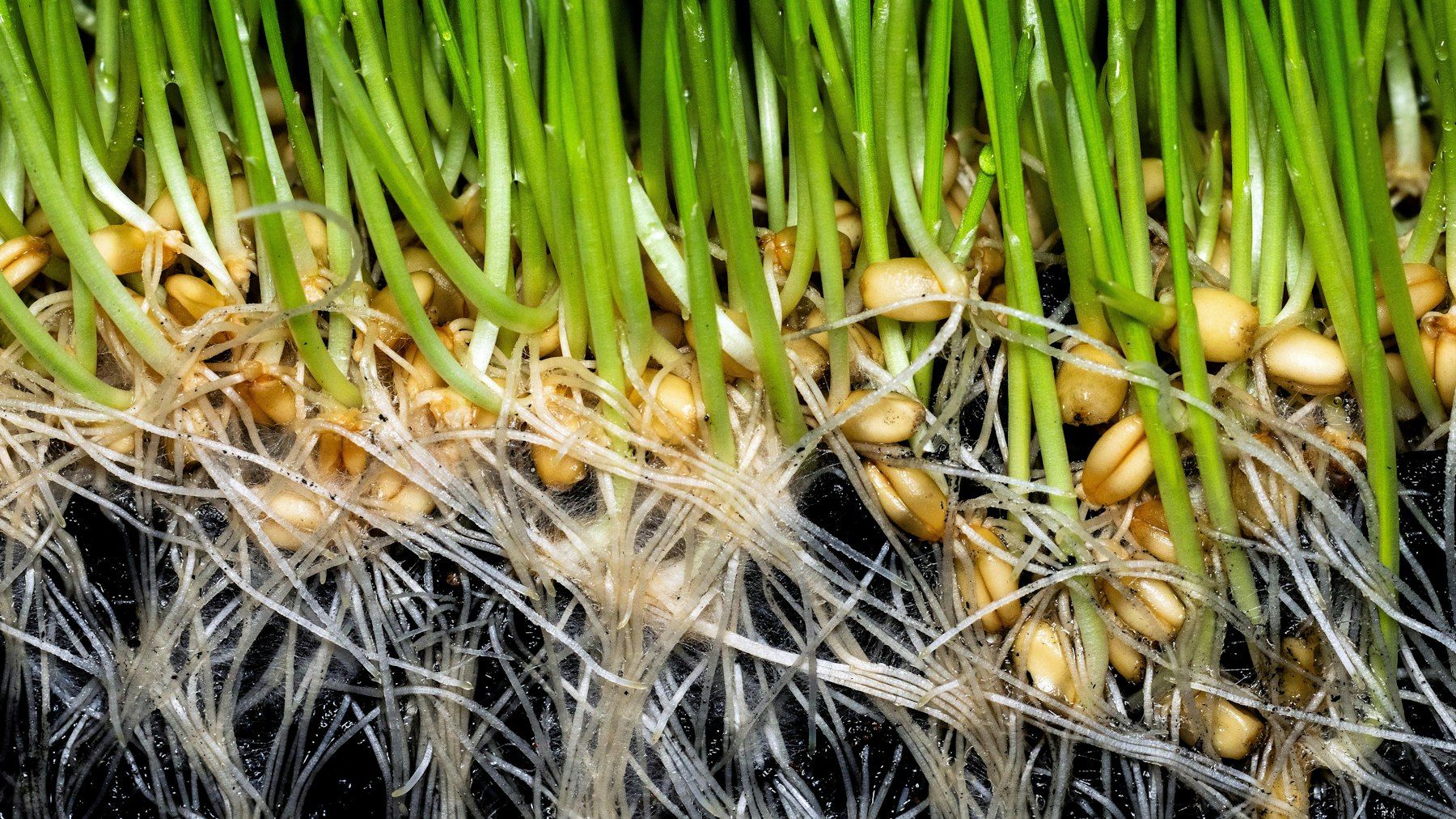
Dried sprouted barley, dry-matter basis. Target ranges are set from the published sprouted-barley literature and our own validation batches; every commercial lot ships with an independent commercial forage-lab panel, and the certificate of analysis for your lot is the number your nutritionist should use.
| Analyte | Target range | Note |
|---|---|---|
| Dry matter | 86 – 90% | Shelf-stable; 45–60 days |
| Crude protein | 14 – 21% | Predominantly rumen-degradable |
| Starch | 18 – 26% | Partially converted to sugar in sprouting |
| Water-soluble carbohydrate | High | Rapidly fermentable energy |
| aNDF | 15 – 30% | Includes root and shoot fibre |
| TDN (calc.) | 70 – 78% | Energy-feed class |
| Phytate reduction vs raw grain | 92 – 97% | Bouajila et al. 2020 |
| Mould, yeast, mycotoxins | Screened | Every lot, documented |
Ranges are provisional targets pending completion of the current validation panel. A lot-specific certificate of analysis is supplied with every delivery and on request before purchase.
| Class | Typical rate | Delivery |
|---|---|---|
| Lactating dairy cows | 2 – 4 lb/hd/day | In the TMR |
| Transition & fresh cows | 2 – 3 lb/hd/day | Close-up & fresh pen TMR |
| Calves & heifers | 0.5 – 2 lb/hd/day | Starter / grower mix |
| Beef — cow-calf | 2 – 4 lb/hd/day | Bunk or with forage |
| Beef — backgrounding / finishing | Set by nutritionist | Growing / finishing ration |
| Horses, pigs, poultry | See applications | Pellet / powder formats |
NovaGreens™ is a supplemental ingredient. Inclusion up to 10–30% of ration DM has been studied without adverse effects; commercial supplemental rates are well below that. Always introduce over 5–7 days and balance the full ration with your nutritionist.
We keep one register and we show it to customers. Green rows are supported by peer-reviewed controlled trials of sprouted barley in the ration. Gold rows are the endpoints our on-farm trials are designed to answer.
| Outcome | Status | What the evidence says |
|---|---|---|
| Feed efficiency | Published | Milk/DMI 1.49 vs 1.43; ECM/DMI 1.85 vs 1.73 (P<0.01) at 10% ration DM. Gain came from lower intake at unchanged yield. Zang et al. 2024, J. Dairy Sci. |
| Nitrogen efficiency | Published | Milk N efficiency 30.5% vs 28.8% (P<0.01); corroborated by Wu et al. 2024. Manure-management and regulatory relevance. |
| Safety at 10–30% DM | Published | No adverse health, metabolic or rumen effects across Kim et al. 2020, Crump et al. 2024, Mohtashami et al. 2026. |
| Phytate reduction | Published | 92–97% reduction, retained after drying. Primary relevance to monogastrics. Bouajila et al. 2020. |
| Rumen development (young stock) | Published: lambs | Increased rumen papillae height, width and surface area in lambs; more amylolytic and cellulolytic bacteria. Alharthi et al. 2023. Calf trial in design. |
| Milk yield | Trial endpoint | Response depends on ration protein: positive at 16.8% CP, negative at 15.5% CP in Wu et al. 2024; null in others. Measured herd by herd. |
| Butterfat & protein % | Trial endpoint | Weekly DHIA component testing in every dairy trial. |
| Herd health, SCC, longevity | Trial endpoint | One non-significant SCC tendency in the literature. Our reference herds report SCC, BCS, treatments and cull reasons over successive lactations. |
| Beef gain, conversion, days on feed | Trial endpoint | Measured in matched-pen trials with individual weights and pen weigh-backs. |
| Supply security & water | Documented | Year-round indoor production; ~95% less water than irrigated forage. A supply-chain fact, not an animal claim. |
Peer-reviewed trials cited were conducted on sprouted barley from a range of production systems and are presented as category evidence, not as validation of any specific NovaGreens™ lot. Full citations in the evidence brief below.
Printable PDFs. Share them with your nutritionist, veterinarian or lender.
The peer-reviewed dairy trial behind the feed-efficiency and nitrogen-efficiency numbers: design, results, and what they mean for a commercial TMR.
Download PDF → Technical briefThe full evidence register with citations — what is published, what is contradicted, and what we are testing. Written for nutritionists.
Download PDF → Trial protocolPaired-control design, randomization, endpoints, measurement cadence, product volumes and what you receive at the end.
Download PDF → Product sheetSpecification targets, feeding rates by class, handling, storage and formats. One page for the feed room wall.
Download PDF → Case study · Young stockThe papillae and microbiome findings that underpin our calf-starter program, and the calf trial designed to confirm them.
Download PDF → On requestIndependent wet-chemistry panel, mould/mycotoxin screen and registration documents for any commercial lot.
Request →Zang Y. et al. (2024). Journal of Dairy Science 107(8):5529–5541. Sprouted barley at 10% of ration DM in lactating cows — feed and nitrogen efficiency.
Wu Z. et al. (2024). Journal of Dairy Science 107(10):7744–7755. Sprouted barley × dietary protein interaction in lactating cows.
Kim D. et al. (2020). Applied Sciences 10(21):7442. Hydroponic barley as a partial substitute in ruminant diets.
Crump A. et al. (2024). Journal of Animal Science, doi 10.1093/jas/skae074. Sprouted barley in dairy rations — rumen and health measures.
Mohtashami B. et al. (2026). Tropical Animal Health and Production 58(7):460. Sprouted-grain inclusion in ruminant rations.
Alharthi A. et al. (2023). Veterinary Sciences 10(1):15. Sprouted barley and rumen papillae development in lambs.
Bouajila A. et al. (2020). Agroforestry Systems 94:1151–1159. Phytate reduction in sprouted cereals.
Pastorelli G. et al. (2024). Annals of Animal Science 24(3):645–656. Review of sprouted cereals in animal nutrition.
Our independent nutritionist and trial statistician are available to walk through the protocol, the analysis and the citations before you enroll a single cow.